The $600 Digital Worksheet
Glowing screens are not the same as growing minds.

If a $600 device is just replacing a $0.05 sheet of paper, we are not integrating technology.
We are making the worksheet glow.
And glowing does not mean growing.
That may sound sharp.
But I have seen it too many times to ignore.
Students are tapping screens.
Dragging boxes.
Typing answers into predefined spaces.
Clicking submit.
The room looks quiet.
The screens are glowing.
The lesson looks modern.
But sometimes, the learning is still sitting in the back seat.
That is the part we have to be honest about.
A classroom can be full of devices and still be light on thinking.
Technology use alone does not guarantee deeper learning.
A digital worksheet is still a worksheet wearing nicer shoes.
The Problem Is Not the Device
I do not want schools to stop using technology.
Not at all.
Technology can help students model ideas, analyze data, design solutions, record explanations, publish arguments, code processes, revise prototypes, and make thinking visible.
That matters.
But the device cannot carry the learning for us.
A tool can support the thinking.
It cannot replace the thinking.
So the better question is not:
Did students use technology?
The better question is:
What did the technology help students create, test, explain, model, or solve that made the learning stronger, clearer, or more visible?
That question changes the conversation.
It moves us away from tool use.
It moves us toward evidence of learning.
Because a device in a student’s hand is not the goal.
Evidence of learning in a student’s work is.
The CREATE Filter
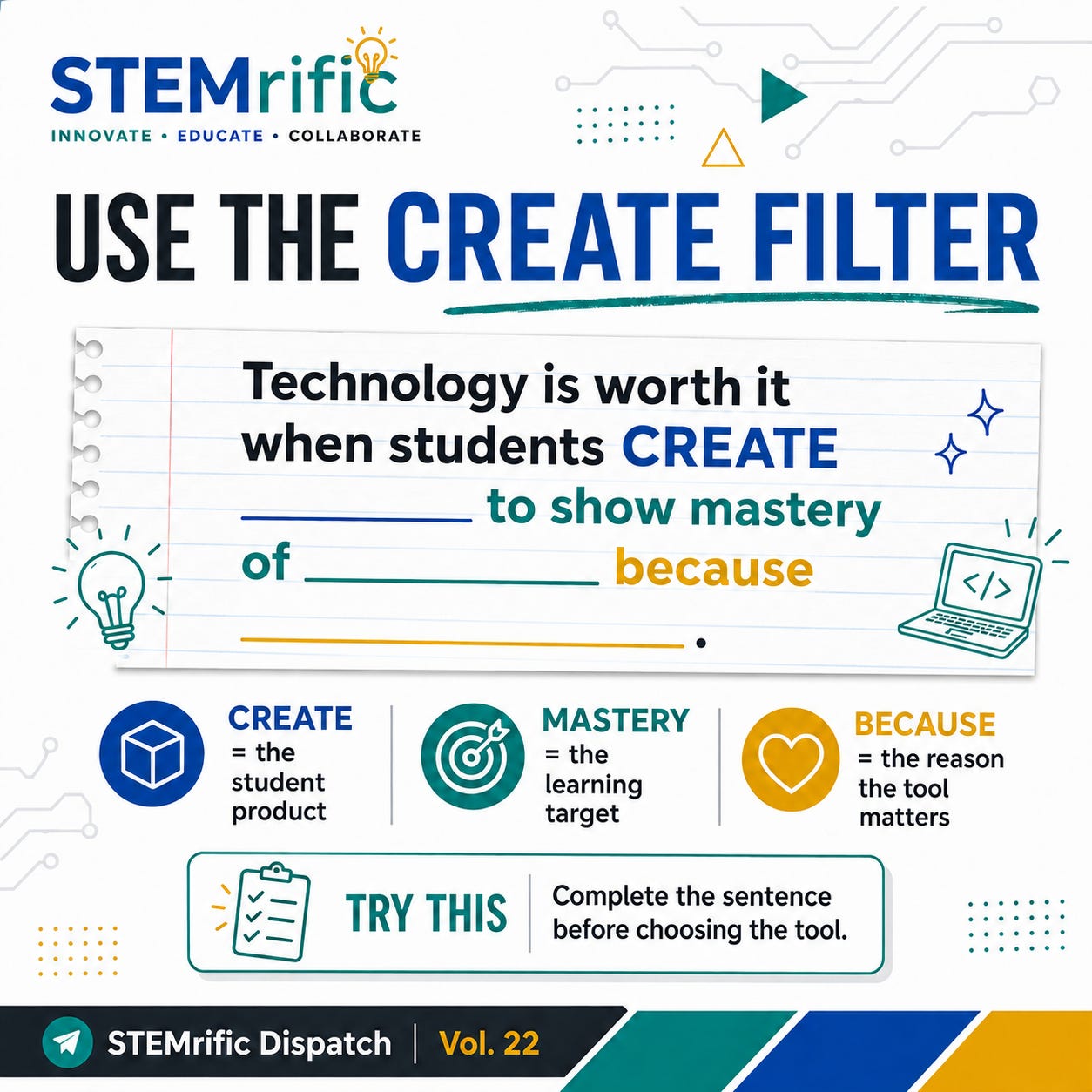
In STEMrific Dispatch Vol. 22, I came back to a simple filter for purposeful technology integration:
Technology is worth it when students CREATE ________ to show mastery of ________ because ________.
That last blank matters.
The because forces us to name the instructional value of the tool.
Not the app.
Not the platform.
Not the shiny feature.
The value.
If students are creating a podcast, why does that format deepen their explanation?
If they are building a model, why does the model make their thinking more visible?
If they are coding a simulation, why does that process help them test a concept in a way paper could not?
That is where technology earns its place.
Not because it glows.
Because it grows the thinking.
Lower-Lift vs. Higher-Lift Tech Use
During your next walkthrough, planning meeting, or coaching conversation, listen for the difference.
Lower-lift tech use often sounds like this:
Students clicked through the assignment.
Students copied information into boxes.
Students watched a video and answered questions.
Students completed the digital worksheet.
Students submitted the task.
None of that is automatically wrong.
Sometimes students need to receive information.
Sometimes they need to practice.
Sometimes they need a quick check for understanding.
But if that is the dominant pattern, the technology may be managing the task more than students are owning the thinking.
That is when the screen glows, but the learning stays small.
Higher-lift tech use sounds different:
Students designed a model.
Students built something original.
Students recorded an explanation.
Students transformed data into a claim.
Students revised a prototype.
Students published for an audience.
Students used the tool to make their thinking visible.
That is the shift.
Not more screen time.
Stronger evidence.
The Quick Audit
Here is the question I would ask any school team:
When students use technology in your classrooms, are they mostly consuming, completing, or creating?
Consuming has a place.
Completing has a place.
But creation is where students start producing evidence we can study, discuss, and improve.
That is where technology becomes more than a device.
It becomes a canvas.
A lab.
A studio.
A stage.
A launchpad.
And that is when the investment starts to make sense.
Because the goal is not glowing screens.
The goal is growing minds.
Try This
Pick one technology-based task from this week.
Ask three questions:
What did students create?
What did that creation reveal about their understanding?
Why did the technology make the learning stronger, clearer, or more authentic?
If those answers feel thin, do not start by chasing a new app.
Start by strengthening the task.
Because the goal is not to make classrooms look more digital.
The goal is to make student thinking more visible.
That is the work.
And that is STEMrific.
Reflection: What percentage of student screen time in your school is spent creating evidence of learning instead of simply consuming or completing tasks?
Drop your estimate in the comments.
I’m also building a practical resource to help leaders and coaches spot the difference between lower-lift tech use and higher-lift student production. More soon.