STEM Implementation: Side Salad, Not Appetizer
What if STEM isn’t failing because of your teachers — but because of where you’re putting it on the menu?

Dr. Warren P. Edwards | DocSTEM | STEMrific
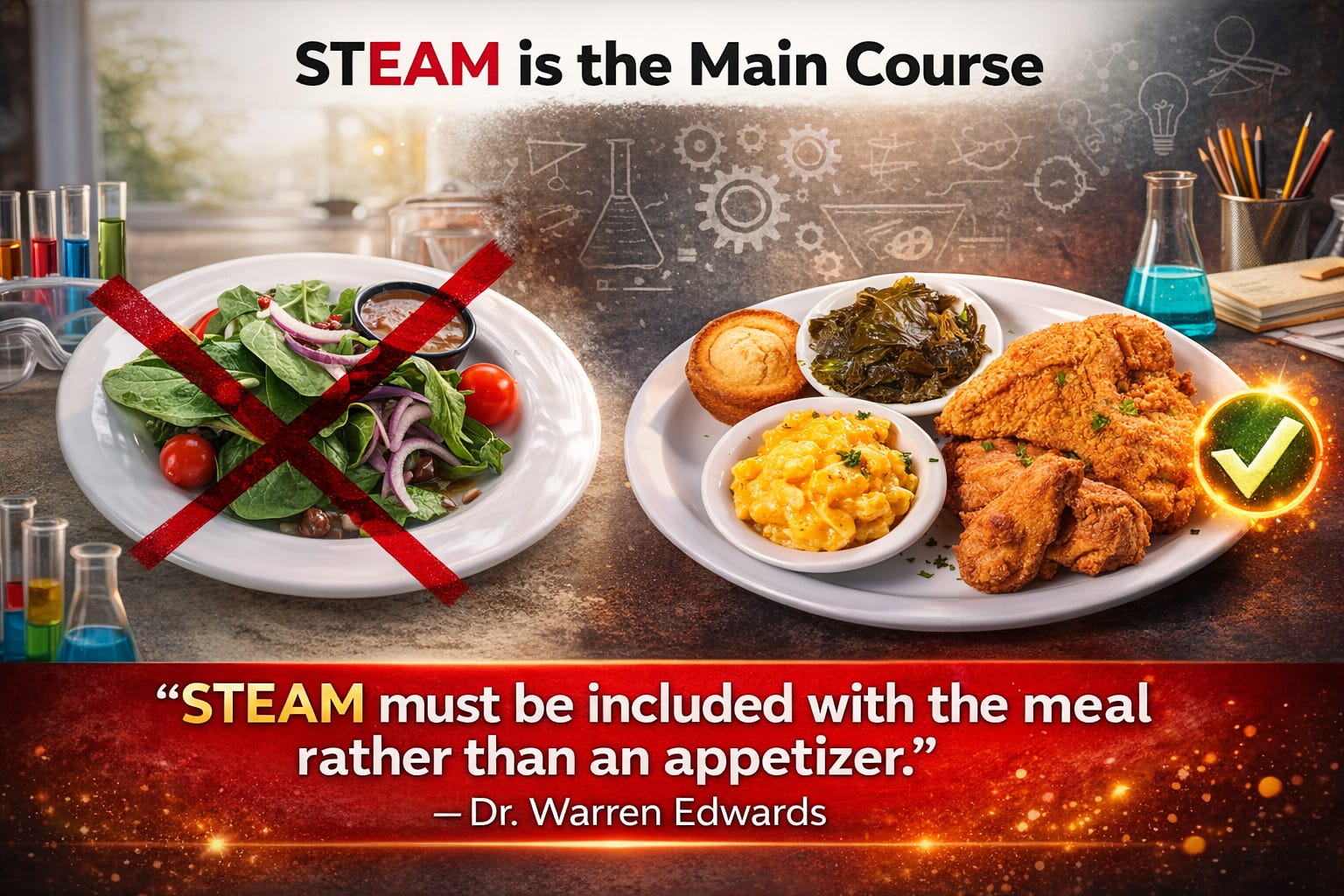
What if STEM isn’t failing because of your teachers — but because of where you’re putting it on the menu?
That’s the question I keep coming back to when I sit with district leaders who are frustrated. They’ve invested in STEM. They’ve run the events. They’ve bought the kits. Teachers are trying. Students seem engaged — at least on the day of the activity. But when you walk classrooms six weeks later, there’s no trace of it. No integration. No evidence. No culture. Just a memory of the day they built something in the hallway.
The problem isn’t effort. The problem is placement.
The Appetizer Problem
Most districts serve STEM like an appetizer.
It comes before real learning. It’s exciting at the moment. Students taste it, enjoy it, and then move on to the main course — which has nothing to do with what they just experienced. The STEM activity lives in isolation. The teacher planned it separately. It connects to no standard, no unit, no throughline.
This is what I call the Chips Before Italian problem. Imagine sitting down at a traditional Italian restaurant and being served salsa and tortilla chips before your pasta arrives. Nothing wrong with chips. Nothing wrong with salsa. But there’s no logical connection to what follows. The pairing is irrelevant. And if you fill up on chips, you may not have room — or appetite — for what actually matters.
That’s exactly what happens when STEM is treated as a one-off event. Random lab days. Isolated engineering challenges. “Fun Friday” activities with no curriculum anchor. Students fill up on the experience. Then the real learning resumes — and STEM disappears from the plate entirely.
The result: STEM fatigue, not STEM culture.
The Tapas Party Exception
Here’s where I have to be precise, because not all appetizers are wrong.
Some districts do something I call the Tapas Party — and it works. A family STEM night with a clear purpose. A school-wide showcase tied to units students actually studied. A district competition where the challenge connects directly to what teachers have been building in class. These events are intentional, communal, and contextual. They build excitement. They connect community to learning. They create entry points.
The tapas party has a reason for existing. Everyone at the table knows why they’re there. The food is varied, the conversation is rich, and the experience is designed to engage — not just to entertain.
The failure mode isn’t the event. It’s the event with no before and no after. The one-off that lives in isolation. The activity that no teacher planned toward and no student connects to anything else. That’s not a tapas party. That’s just chips.
The Side Salad Standard
Integrated STEM works like a well-designed side salad.
It arrives with the meal — not before it. It complements the main course rather than competing with it. It’s present for every diner, every time. And when it’s done right, the meal is genuinely incomplete without it.
This is what daily STEM integration looks like: planned during unit design, not added on afterward. Standards-aligned. Connected to ELA, math, science, social studies — whatever the main course is. Accessible to every student, every day. Not a special event. Not a reward. Part of how learning is served.
The research doesn’t argue for STEM as enrichment. It argues for STEM as infrastructure.
Meta-analyses show integrated STEM produces effect sizes 2–5 times larger than traditional methods. Motivation, creativity, collaboration, problem-solving, content mastery — all statistically significant gains when STEM is embedded rather than isolated. Zhang & Ma (2023) found achievement effect sizes of g = 0.65 across 60+ studies. Meng (2023) found g = 1.64 in STEM-specific project-based learning contexts. López-Belmonte et al. (2022) measured all 11 learning dimensions and found integrated STEM outperformed traditional instruction across every single one, all at p < .01.
The data is not subtle. The side salad outperforms the appetizer every time.
The Mindset Shift Districts Need
The question most districts ask: When do we do STEM?
The question that changes everything: How does STEM live inside what we’re already teaching?
One question treats STEM as an event to schedule. The other treats it as a design principle. One produces appetizers. The other produces a complete plate.
This is the shift I work with district leaders to make — moving from STEM as a program you run to STEM as an implementation infrastructure you build. That means governance-informed planning. It means coaching systems that reinforce integration. It means walkthrough tools that measure whether STEM is actually embedded in instruction — not just present on a schedule.
Culture isn’t what you celebrate once a year at a STEM fair. Culture is what students do when no one is directing them. And you can’t build that culture with chips and salsa.
The Challenge
Take an honest look at your school’s menu.
Where does STEM actually live right now? Is it showing up as a side salad — planned, integrated, present for every student, every day? Or is it an appetizer — exciting, occasional, and disconnected from the main course?
And if it’s an appetizer — is it at least a tapas party? Intentional, communal, tied to something larger?
The meal is incomplete without the side salad. So is a school without integrated STEM.
STEM appetizers work at tapas parties — intentional, communal, contextual. Random chips before Italian? Disconnected calories. Make STEM the side salad: planned, relevant, enhancing every learning meal.
— Dr. Warren P. Edwards, STEMrific
Dr. Warren P. Edwards is a National STEM Systems Strategist and founder of STEMrific. He helps districts and STEM organizations translate policy into sustainable classroom practice through governance-informed system design, measurable STEAM culture, and purposeful technology integration. Learn more at STEMrific.com.